
About 50% of “high-class” professionals feel that their recent job change was successful.
Results highlight the importance of matching candidates and jobs based on factors that are difficult for AI to assess, such as organizational fit and potential for success.
en world Japan K.K., one of Japan’s largest recruitment firms specializing in high-class and global talent (head office: Chuo-ku, Tokyo; President: Yusuke Yamamoto), conducted a study on the key success factors in “high-class” job changes and recruitment.
In recent years, rapid advances in technologies such as AI have accelerated the use of automation in recruitment and job seeking. Increasingly, entire process ─from matching candidates with job openings to conducting interviews─ are completed by AI. While there are merits to using AI in recruitment activities, such as greater efficiency and lower costs, it also raises new concerns about whether a candidate’s fit with an organization, their potential for success after joining, and other essential factors are being adequately assessed.
Against this backdrop, en world Japan K.K. conducted a study on the key success factors in “high-class”* job changes and hiring.
*For this study, “high-class” talent and positions are defined as those with an annual salary of eight million yen or more.
Survey Results Overview
1. About 50% of “high-class” professionals feel that their recent job change was successful.
Detailed Survey Results
1. About 50% of “high-class” professionals feel that their recent job change was successful.
First, 55% of respondents who both earn an annual salary of 8 million yen or more and who had changed jobs within the last five years indicated that their job change was “successful.” The remaining respondents answered that they either “cannot say either way” if their job change had been successful or that it was “unsuccessful,” meaning that nearly half of all respondents did not feel that their job change had been a success. [Figure 1]
[Figure 1] Overall, do you consider your transition to your current job a “success”?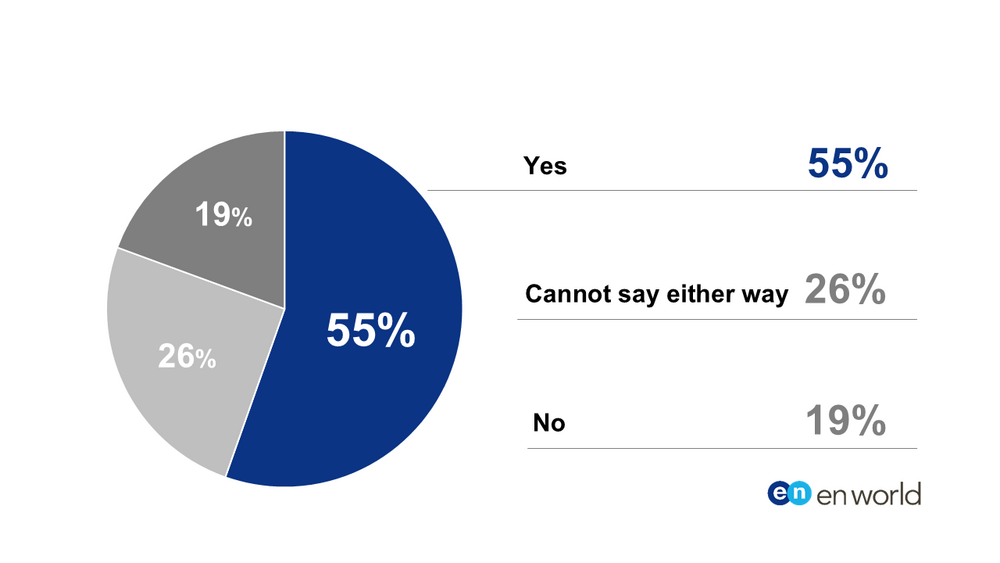
2. Potential culture fit is about 1.5 times more important for high-class professionals to feel that their job change was a success than for people earning less than 8 million yen annually.
Next, we compared the factors considered important for a successful job change between respondents earning 8 million yen or more annually and those earning less than 8 million yen.
Notably, there was a significant difference between the two groups regarding the importance placed on being able to relate to the company’s culture and values. Among respondents earning 8 million yen or more annually, the share who identified this as an important factor was about 1.5 times greater than that of lower earners who answered the same, representing a 19-point gap.
High-class respondents were also more likely to indicate that feeling like their job “brings out their abilities and contributes to their personal growth” and being able to “deliver results and contribute to business performance and organizational success” were important, resulting in 18- and 16-point differences, respectively, compared to their lower-earning counterparts.
Overall, the findings show that high-class professionals tend to place greater importance on more factors that concern their potential within the role and the organization—factors that are often difficult to assess from just a job description. [Figure 2]
[Figure 2] After changing jobs, how important are the following factors in determining whether you can say you are “successful” at your new company? (Percentage of respondents who answered “important.”)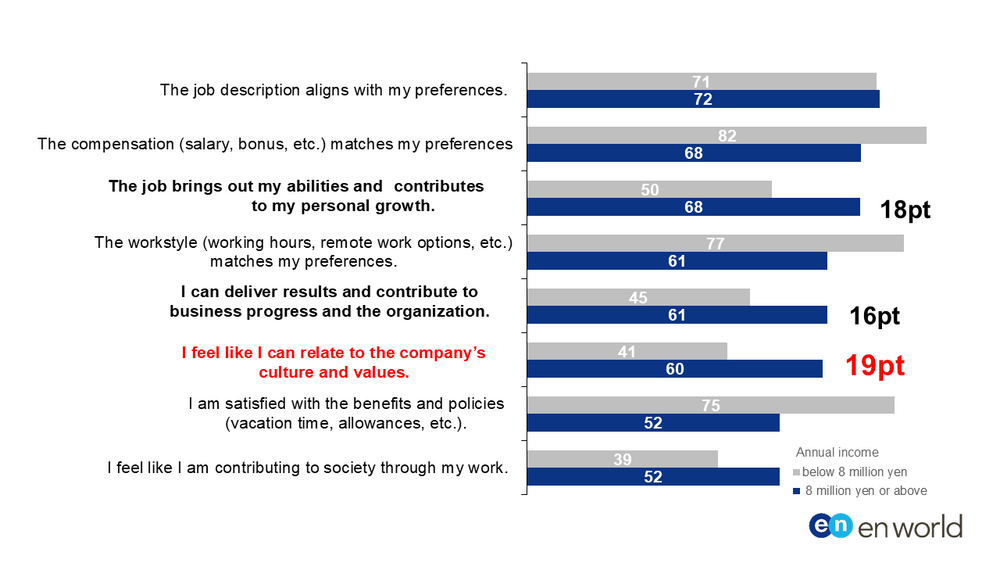
3. Regarding matching candidates with open positions, both job seekers and employers face challenges related to intangible success factors, such as organizational fit and potential for success.
Finally, we asked both candidates and companies applying and hiring for roles with annual salaries of 8 million yen or more to indicate which factors were important for success after hiring.
While a high percentage of job seekers indicated that having a job that “brings out their abilities and contributes to their personal growth” was an important factor indicating success in their new role, there was a 17-point gap in the percentage who felt they were actually successful in this area. This was followed by a 16-point gap between those who indicated that being able to relate to the company’s culture and values was important, versus those who felt they could actually relate. [Figure 3]
Similarly, on the hiring side, there was a significant gap (16 points) between the percentage of respondents who indicated that a candidate’s “alignment and fit with the company’s culture and values” was important versus the percentage who felt their new “high-class” talent was successful in that area. There was also a 15-point gap between importance and actual success regarding a new hire’s “ability to drive transformation with an understanding of the organizational context.” [Figure 4]
These results suggest that, on both the job seeker and hiring sides, there are challenges in matching intangible factors such as organizational fit and potential for success after joining.
[Figure 3] Job seekers earning an annual salary of 8 million yen or more:
■After changing jobs, how important are the following factors in determining whether you are successful at your new company? (Percentage of respondents who answered “important.”)
■ At present, can you say that you are succeeding in these areas? (Percentage of respondents who answered “succeeding.”)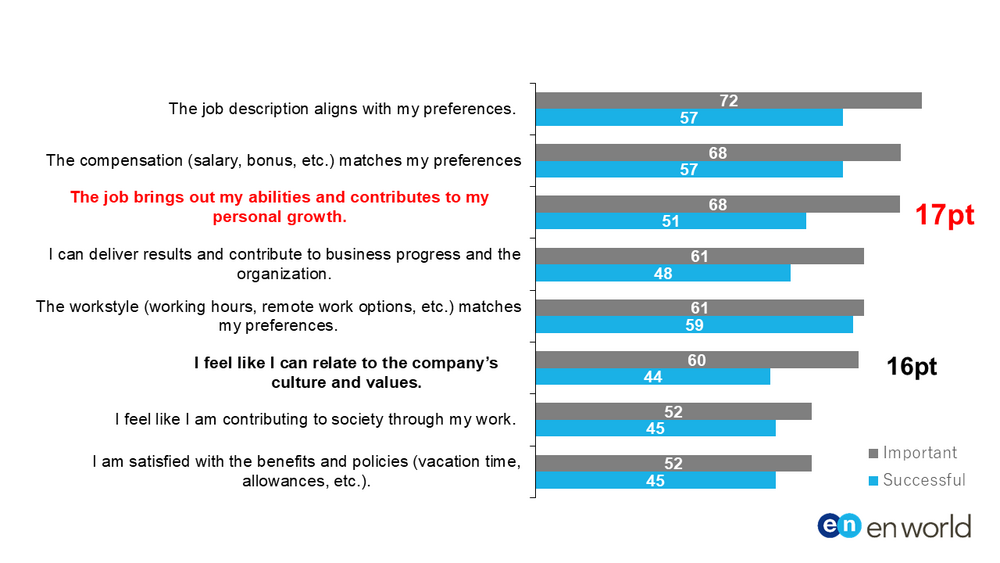 [Figure 4] For companies hiring for positions with annual salaries of 8 million yen or more:
■When hiring high-class talent, how important do you think the following factors are in determining whether they are successful after joining the company? (Percentage of respondents who answered “important.”)
■ At present, can you say that the high-class talent you have hired is succeeding in the following areas? (Percentage of respondents who answered “succeeding.”)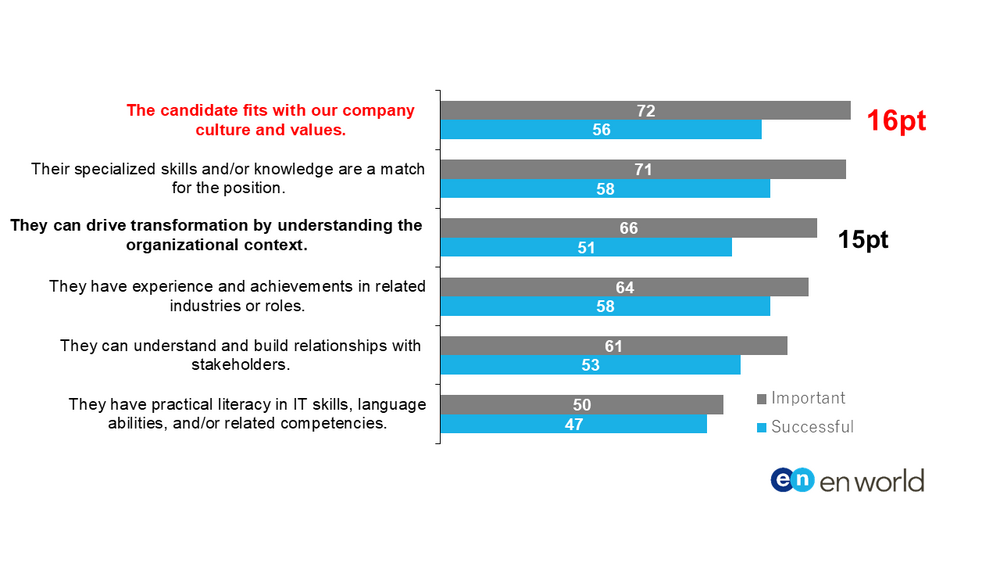
Analysis
The results of this study revealed the importance of matching candidates and companies based on intangible factors, such as candidates’ ways of thinking and values, as well as the organization’s context and culture, to ensure success in high-class job changes and recruitment.
Considering that such factors are difficult to assess from textual information alone, such as job descriptions and résumés, the results of this survey suggest that purely mechanical methods of matching candidates with organizations, such as AI that rely solely on explicit criteria, may be insufficient for successful matching, especially when supporting job changes and recruitment for high-class professionals.
Take candidates’ potential into account with en world’s recruitment and hiring support
Under its unique mission of “Enabling Success” by maximizing the potential of people and organizations and co-creating the future, en world’s end goal is never a simple placement or hire. Instead, we provide consultation from a mid- to long-term perspective, working closely with both job seekers and companies.
By proposing options and supporting decision-making with a forward-looking view of individuals’ potential for achievement and success, we aim to bring together the right people and companies in ways that are difficult to replicate through AI alone.
What "Enabling Success" means at en world
URL : https://www.enworld.com/en/company/enabling-success/
[Survey Overview]
Method: Online survey
Region: Nationwide
Survey Period: March 10–11, 2026
Sample size:
-Job changers: 211 total
・Respondents with an annual income of 8 million yen or more: 103
・Respondents with an annual income of less than 8 million yen: 108
・All respondents changed jobs within the past five years
-Hiring companies: 135 total
・Respondents were manager-level employees or above who had filled a position with an annual salary of 8 million yen or more within the last three years.
Response Format: Single answer
About en world Japan
en world Japan is a recruiting firm specializing in global human resources, specializing in recruitment and job placement support for middle to high-level positions at foreign and Japanese multinational companies. Through services such as permanent placement, executive search, professional staffing, and RPO, the company supports both individuals and organizations in achieving their goals and navigating growth and change as a long-term partner.
Press Contacts
en world Japan K.K. 12F Tokyo Square Garden 3-1-1 Kyobashi, Chuo-ku Tokyo, 104-0031
Email : enworld-pr@enworld.com